
Adapting Viticulture in Southern France: Strategies Amid a Worsening Water Crisis
Introduction
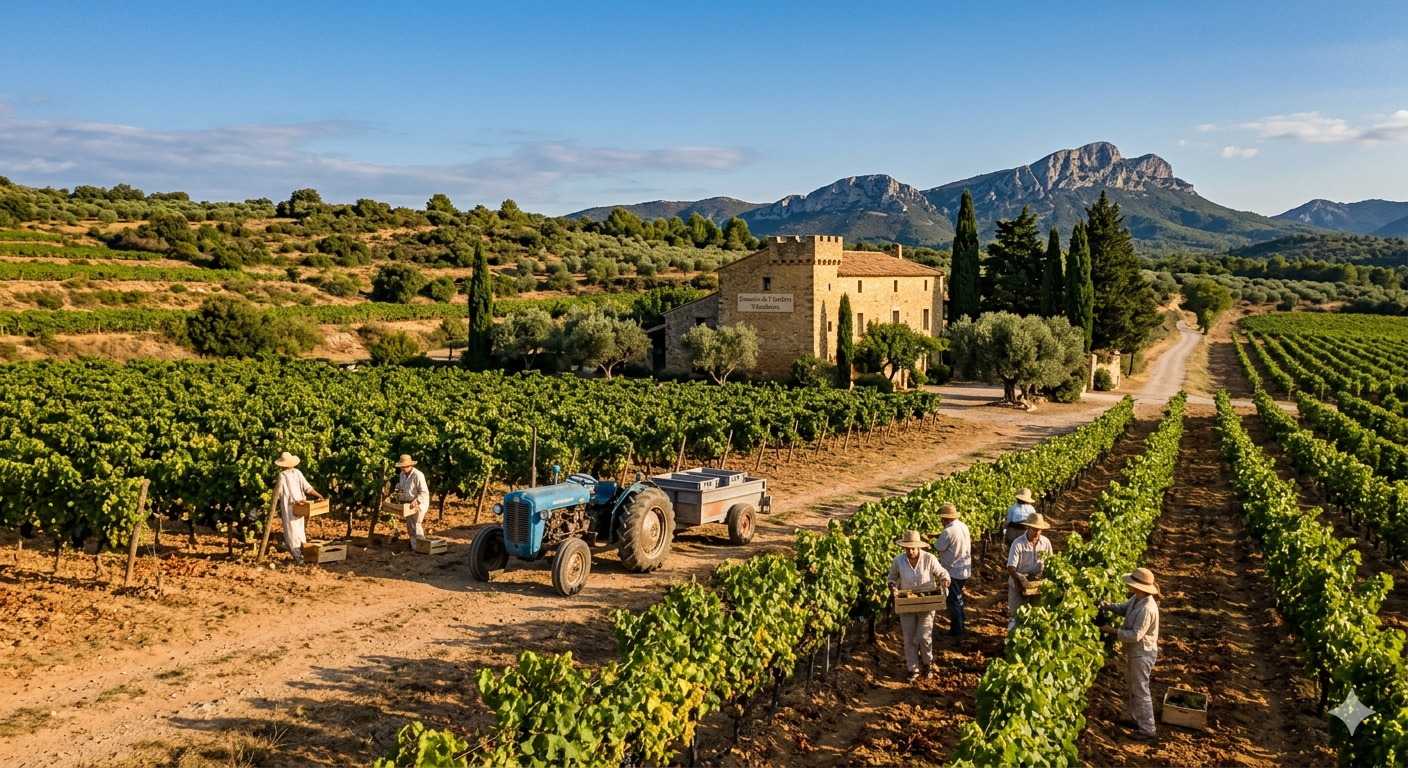
Following the hottest month on record, July of 2023, the South of France has faced drought-like conditions leaving over 30,000 people without dependable sources of water (O’Shea, 2023; Wybrew, 2023). This has had drastic effects on the quality of life for affected inhabitants, and this problem is not isolated to the South of France. The European Drought Agency has stated that from the year 2000 to 2022, the European drought-impacted area has risen from 167,000 km2to 630,000 km2, which equates to a 277% increase in just over 20 years, with a majority of that land used for agriculture (Fig. 1). They also note that soil moisture since 2020 has been lower than the average moisture levels between 2000 and 2020 (EEA 2025).
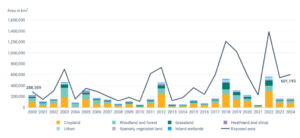
Figure 1. Annual area of drought impact (km2) from 2000-2024 (European Environment Agency (EEA) 2025).
Worldwide, temperatures are rising while drier conditions spread. Research led by Monica Caparas displayed a probability for crop yield failure to be 4.5 times worse by 2030 and 25 times worse by 2050. Due to increasing water scarcity, longstanding agricultural sectors will see increasing challenges in producing their crops to the same extent as in years past (Caparas, et al. 2021). These droughts are detrimental to crop production: not only does a lack of water stunt crop growth significantly, it also increases the cost of production. When farmers have to outsource their water supply, the cost of production rises, which impacts both the cultivator and the consumer.
When applied to viticulture, or the process of cultivating grapes for wine production, droughts are dangerous because they reduce both the quality of grapes and the harvest yield. When under stress due to a drought, grapevines undergo stomatal closures to reduce transpiration, leading to a reduction in photosynthesis which lowers the quantity of grapes grown (Gambetta, 2020). A decrease in water level is particularly treacherous in the pre-veraison stage of viticulture, or the stage before the grapes ripen. A common response to drought in pre-veraison grapes is drought-induced shriveling, which alters the composition of sugar, acid, and phenolic content of the grapes–affecting the overall quality of the wine. With wine being a valuable cultural and economic aspect of southern France, especially in the southern region of Occitanie, a decrease in wine quality could prove detrimental to the region. Droughts and water shortages have vast negative impacts on viticulture: decreasing the quality and quantity of grapes grown, as well as threatening the lifestyle of vignerons in southern France.
Languedoc-Roussillon, consisting of 5 departments across southern France and including major cities like Montpellier, Nîmes, Narbonne, Sète, and Perpignan, is the largest wine-producing region in France in both vineyard area and quantity of wine produced.
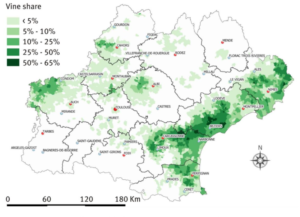
Figure 2. Concentration of vineyard land in Occitanie, as a percentage (DRAAF Occitanie, IGN BD Carto, Customs CVI 2018)
In this region, viticulture is both a way of life and a cornerstone of the region’s economy, culture, and heritage, evident in the strict standards that guide regional wine-growing practices. Such standards are institutionalized through the Protected Designation of Origin (PDO, or AOP in French) and Protected Geographical Indication (PGI, or IGP in French) frameworks. These are rules and regulations imposed by wine-making regions on vignerons to control quality and ensure the wine produced from that region is aligned with the terroir, or the natural climate of the region combined with its longstanding cultural practices. A wine made in accordance with its territory’s PDO signals that it has a strong connection to its terroir and is therefore high quality. Some examples of this include Bordeaux wine and Champagne.
PGI, on the other hand, is typically more lenient with farming practices and regulations, allowing for more freedom in the wine-making process; it is, however, not as esteemed as PDO wine, so it could affect consumers’ choices (Marr, 2023). While following PDO or PGI guidelines is not mandatory to produce wine, if winemakers want to market their wine with the name of the region, they must adhere to all written standards. The intense regulation of the winemaking process exemplifies its significance to French culture and economy. Therefore, it is necessary to preserve longstanding winegrowing culture as well as impose modern methods to grow wine in a changing environment.
Due to the prevalence of droughts in the South of France and its increasingly harmful effect on vineyards, both farmers and scientists are searching for viticulture practices that can maintain a bountiful production of grapes even in low-water conditions. This report aims to capture the most efficient and effective practices that wine growers in the South of France, particularly the Occitanie Region, could implement in their vineyards to offset the increasing environmental shifts while upholding traditional values.
Methods
To gain insight into the severity of the water crisis in southern France and the measures farmers must implement with their vineyards, an interview was conducted with Bertrand Bosc, a local tour guide of vineyards in the Pic Saint-Loup region of Occitanie. Bosc has been a guide for over 15 years in the Montpellier vineyard area and has witnessed firsthand the changes around Montpellier and areas of southern France while having a thorough understanding of grape growing and wine production. We also spoke with Agathe Frezouls, co-owner of an eight-generation-long vineyard in the region, Enclos de la Croix. Literature reviews were also conducted to gain further insight into the current viticulture practices and their efficiencies, as well as viticulture resistance strategies in the presence of droughts.
Results
A. Current Changes
When asked about the specific changes in the environment Bosc has witnessed, he explained that when he started giving tours 15 years ago, there would be around 1000 mm of rain each year, but as of May 2024 there is only around 500-600 mm of rain. There is a clear shift in the environment in southern France with the terroir becoming more arid and warmer. As such, he explained that it has become harder to produce fruitful crops each year and that he has seen a general decrease in supply across the region (Bosc, personal communication, June 13, 2024). As the climate shifts, Bosc explained how winegrowing is becoming more popular farther north, with vineyards appearing in Belgium and South England. However, in southern France, more farmers are growing other produce such as olives because wine production is becoming less fruitful (Bosc, personal communication, June 13, 2024).
The interview with Frezouls allowed much more insight into French wine growers’ difficulties amid climate change. When asked about how she expects wine growing to change in coming years, she predicts that most farmers will have to begin using irrigation. Frezouls notes her concern with irrigation as her vineyard, Enclos de la Croix, tried irrigation previously and found that the vines grew dependent on it, and therefore less perseverant amid drought compared to plants watered infrequently by the rain. Also, she parallels Bosc’s assessment that farmers are increasingly diversifying beyond wine production: her own family has begun expanding into fruits, olives, vegetables, and paper as viticulture alone becomes less reliable. (Frezouls, personal communication, June 15, 2024).
B. Nature-Based Adjustments
Currently, southern France wine growers are implementing various methods to minimize their use of water while maintaining their vines. First, the location where wine growers place their vines is intentional: grapes are grown in valleys so that runoff water will flow down the hills into the vineyard. Also, soil with pebbles is used to minimize the heat from the sun which
further dries out the soil. The types of grapes grown also vary greatly by the soil type. While there are specific grapes that must be grown among appellation regulations, farmers choose grapes that can survive in drier soil and with little rain. Drought-resistant grapes from areas like Greece, Spain, and Portugal are increasingly common in southern France (Bosc, personal communication, June 13, 2024). These grapes, such as Pinot noir, Merlot, Syrah, and Cabernet Sauvignon are more resistant to drought and therefore more likely to remain viable over the coming years (Lamarque, et al. 2023). The National Research Institute for Agriculture, Food and Environment (INRAE) is tasked with creating hybrid grape varieties to withstand drought, high heat, and many other afflictions. Hybrid varieties are very promising, with Bosc and Frezouls speaking highly of them. Frezouls has been growing a hybrid variety that has proved incredibly fruitful, one that can not only withstand the high heat and drought, but is resistant to mildew that grows from the humidity due to close proximity to the Mediterranean Sea (Frezouls, personal communication, June 15, 2024).
Both Frezouls and Bosc also expressed the benefit of using horses instead of tractors to till the soil because horses reduce soil compaction, allowing better soil aeration and infiltration. Greening is also a common practice, in which weeds and plants grow between the rows of grapevines. This practice covers the soil to reduce both heat and soil erosion, and provides root-competition for the grapevines, which improves the plant’s resilience by forcing the roots to reach deeper into the ground and find more groundwater. At the Frezouls’ Enclos de la Croix, they are growing large trees that provide shade for the grapes and act as a natural insecticide from birds that live in the trees and eat insects. At the base of the trees, wool is placed from their sheep–which graze on the weeds–allowing the trees to better retain their moisture (Frezouls, personal communication, June 15, 2024). On their own, each of these implementations has limited impact, but when combined they vastly improve the vines’ health and success.
Interviews with wine growers in Germany and Switzerland in addition to France highlight the growing concern across Western Europe. A 2023 report by Gaël Bohnert and Brice Martin notes the importance of ground coverings, specific grape varieties such as hybrid grapes that are more resistant to drought, and integrating irrigation to combat climate change and drought-like conditions. Ground coverings are praised as a rudimentary implementation to retain moisture while not interfering with PDO regulations (Bohnert G and Martin B, 2023). However, irrigation is widely viewed unfavorably due to its reduction in grape quality and disruption of a terroir’s PDO regulations–reducing marketability and cultural ties to the wine (Frezouls, personal communication, June 15, 2024).
C. Wastewater Treatment
A recent study led by Christine Ayache, a member of the environmentally-focused company Veolia specializing in water treatment and filtration, proposes a new combatant to the growing water crisis. They determined that less than 1% of wastewater is currently being treated and reused in France, which could then be used for irrigation. From 2013-2015, they tested two types of grapes with irrigation of water given tertiary treatment (class B—drinkable) and tested the grapes and soil for heavy metals and microbiological presence. After year 3, 100% of water reached level B classification, they found no significant heavy metals, and bacteria levels were well within regulation. They found little difference in grape taste and alcohol content of wine between treated wastewater (WW), potable water (PW), and surface water (SW) by 2015 (Fig. 3). As noted by the investigation, results “demonstrated the feasibility of applying this process for vine irrigation while effectively managing health and environmental risks” (Ayache, et al. 2022). Irrigation is the leading solution to vineyards lacking water, with significant increases in irrigation use across southern France. As 70% of freshwater is used for agriculture, and with the growing scarcity of potable water, the ability to treat wastewater could revolutionize irrigation by allowing continued use in coming years (Ayache, et al. 2022).
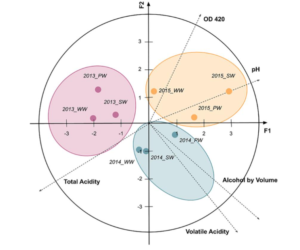
Figure 3. Analysis of physico-chemical composition of wine from 2013-2015 (Ayache, et al. 2022, adapted from Etchebarne-Marjotte, et al. 2016)
D. Irrigation
The use of irrigation has been steadily increasing in viticulture in Southern France. By 2017, an estimated 32,000 hectares of irrigated vineyards existed in Languedoc-Roussillon, accounting for 40% of all irrigated crop types in the region. Between 2008 and 2019, over 23,700 hectares of vineyards added irrigation systems in the Languedoc-Roussillon region (Cambrea, et al. 2021). In southern France departments, around 20% of vineyards currently use irrigation (compared to 4% in 2000), and an estimated 50% of vineyards will need irrigation by 2030, according to Jean-Marc Touzard, director of research at Montpellier’s French National Research Institute for Agriculture, Food, and Environment (INRAE) (Nuwer 2023). Irrigation is currently the leading solution to the lack of water in the region, with more farmers turning to irrigated farms to maintain their vines.
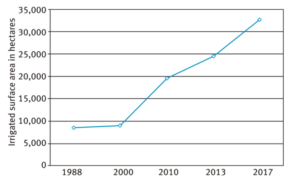
Figure 4. Number of irrigated wine-growing areas in Languedoc-Roussillon, in hectares (RGA 1988, 2000, 2010, Agreste 2013, AIRMF 2017)
While irrigation is the leading implementation wine growers are turning to, longstanding French tradition prohibits the use for some. Each terroir has its own appellation rules for farmers to include PDO or PGI on the wine bottle. While the regulations are different in each terroir, one rule is common throughout southern terroirs: no irrigation is allowed past initial growth. Policy implementations in 2006 and 2017 banned irrigation from August 15 until harvest, allowing irrigation during summer, but more recent changes have allowed irrigation year-long in some regions (Cambrea, et al. 2021).
Even then, Bosc expresses why so many wine growers disapprove of irrigation on their vines: “If you do irrigation you play with the terroir” (Bosc, personal communication, June 13, 2024). While for some, the benefit of irrigation may outweigh the cost of losing the PDO or PGI designations, for others, leaving crops to be treated by the climate naturally is integral to their culture and tradition. “They have rules here, they have requirements. [To] follow the climate and [not] mess with it is French tradition…let the grapes grow naturally” (Bosc, personal communication, June 13, 2024). It is not just the name on the bottle, but a fundamental principle French wine growers follow.
The general consensus is a desire to remain rooted in one’s terroir, and what wine growers dislike about irrigation is the artificiality of watering the vines—manipulating the natural growth process of the region’s climate. Also, irrigating adult vines can be more harmful than good, as both Bosc and Frezouls noted that irrigating makes the plants “lazier.” Additionally, irrigation requires large amounts of water to maintain the crops, which may not be sustainable as drought progresses. Although irrigation can help sustain vines during increasing drought, vine dependence on irrigation, large water use, and French appellation laws make it unpopular with most winemakers.
Discussion
While there are many proposed solutions to managing the water crisis in the winemaking sector, some have proven more fruitful than others in maintaining quality production, as well as satisfying the regulations imposed by PDOs and PGIs.
Traditional irrigation systems are not recommended to combat droughts among wine growers for a plethora of reasons. Primarily, manually watering the plants often does not work ecologically. As detailed by Bosc, the grape vines become “lazy” after manual watering and become more fragile and susceptible to drought. Regulations imposed by both governments and PDO also make irrigation a less attractive strategy for wine growers; according to most PDO regulations, irrigation is strictly forbidden because it separates the taste of the wine from the terroir. Irrigation with the usage of clean water is also an irresponsible method of farming grapes, as it only depletes the local water supply and worsens the drought problem of that area.
It is predicted that with worsening drought conditions, one of the first sectors to undergo water restrictions to ration water is the agricultural sector. Therefore, even if viticulturists invest time and money to build irrigation systems on their property, there is a possibility that they would not be able to use them in the future. Furthermore, if the plants become reliant on outside sources of water, then a reduction in water availability would be detrimental to the plants, potentially causing mass crop failure. Using treated wastewater as irrigation at the beginning of the grapes’ lives has proven to be beneficial without reducing the quality or taste of the wine. However, this is recommended only in the most extreme cases, when irrigation is the final resort.
Irrigation will only worsen the water shortage problem and the resilience of the grapes, so it is necessary to find solutions to make the grapes themselves drought-resistant. Because of this, we recommend using ground coverings to retain moisture and, if necessary, grow a different variety of grapes. Growing ground coverings around the grape vines, often referred to as
greening, has many benefits for both the plants and the farmers. Viticulturists can opt to manually choose what secondary plants they will use as ground coverage, and we suggest the usage of legumes to optimize food production. Allowing nature to overtake and using native plants as ground coverage is also highly recommended, as it protects the biodiversity of the region while also staying in tune with the terroir (which can be used as a marketing or promotional tool). In addition to moisture-retaining, greening will reduce soil erosion experienced throughout the vineyard, which will in turn maintain the soil’s fertility. Another benefit of ground coverings is that they are allowed with PDO regulations, meaning that farmers can employ this strategy without losing credibility, and potentially customers, from their terroir.
The final solution we recommend implementing is using different varieties of grapes in the wine production process. Certain varieties of grapes are more drought-resistant than others, specifically grapes originating from Spain, the French Rhone Valley, and Italy. If necessary, vignerons should begin growing more drought-resistant grapes to adapt to the drought-inflicted terroir. However, a downside to changing grape varieties is that it may not be allowed by a region’s regulations, so there is a risk that the farmer would lose credibility. It is for this very reason that we suggest that PDO and PGI regulations should adapt to fit the needs of farmers growing grapes in territories that are undergoing droughts and that are losing their natural ability to harvest grapes. If droughts worsen and temperatures rise, there may be an extinction of Protected Designation of Origin or Protected Geographical Indication wines in the South of France as viticulturists are not able to adhere to the appellation rules to maintain production.
It is also interesting to note the differences and similarities between scientific studies and what is currently being implemented by wine growers. Studies have shown a rise in irrigation around vineyards and praise its usefulness in the winemaking process while viticulturists across borders reject the idea due to its impracticality. However, both farmers and researchers agree on the usefulness of ground coverings and drought-resistant grape varieties. In order to preserve the viticulture in the South of France and other drought-inflicted areas, further research should be conducted on other possible strategies to combat drought-like conditions in the grape growing process.
Conclusion
To conclude, viticulture is deeply ingrained into the culture, economy, and history of the South of France, and climate change’s worsening of conditions elicits the need for differing strategies to adapt the winemaking process to drought. After speaking with local wine growers and specialists, as well as conducting outside research, we have concluded that the best way to maintain moisture in the soil and combat dry environments is by greening, or growing additional ground coverings to stop soil erosion. Another option is utilizing more drought-resistant grape varieties or hybrid strains, but this may not be allowed by the farmer’s PDO or PGI and could impair cultural ties to one’s terroir and hinder consumer interest.
The final solution recommended is irrigation, but this strategy raises the most controversy and should only be used in desperate times of drought. Irrigation can reduce the yield or quality of grapes while simultaneously depleting the natural water supply of a region, exacerbating water crises for commercial gain. If irrigation is necessary, it is recommended to use treated wastewater instead of clean drinking water to preserve potable water for drinking. As the water crisis intensifies in the South of France, the future of viticulture is under serious threat, demanding urgent research to protect a tradition that is both culturally invaluable and economically essential.
Bibliography
Ayache C, et al. (2023). Water reuse for vine irrigation: from research to full-scale implementation. Water Reuse, 13(3), 295-304.
https://iwaponline.com/jwrd/article/13/3/295/96325/Water-reuse-for-vine-irrigation-from research-to. Doi: 20.2166/wrd.2023.054.
Bohnert G, Martin B. (2023). Impacts of climate change induced drought and adaptation strategies in wine-growing in the Rhine Valley (France, Germany, Switzerland). Total Environment Research Themes, 8, 100081. Doi: https://doi.org/10.1016/j.totert.2023.100081.
Caparas M, et al. (2021). Increasing risks of crop failure and water scarcity in global breadbaskets by 2030. Environ. Res. Lett. 16. https://iopscience.iop.org/article/10.1088/1748-9326/ac22c1/meta. Doi: 10.1088/1748-9326/ac22c1.
Cambrea L, et al. (2021). Live from the regions–vine irrigation in the former Languedoc-Roussillon region: production potential maintained through water savings. Sciences Eaux & Territoires, 32, 28-33. https://hal.science/hal-03440259v1/document. Doi: 10.14758/SET-REVUE.2020.4.05.
Drought impact on ecosystems in Europe. (2025). https://www.eea.europa.eu/en/analysis/indicators/drought-impact-on-ecosystems-in-europe?activeAccordion=546a7c35-9188-4d23-94ee-005d97c26f2b.
Fournée M. (2023). Comprendre l’impact de la sécheresse sur les vignes et les stratégies d’adaptation. Riviera Cellars Wine Supply French Riviera. https://www.rivieracellars.fr/en/comprendre-limpact-de-la-secheresse-sur-les-vignes-et-les-strategies-dadaptation/.
Gambetta GA, Herrera JC, Dayer, S, Feng Q, Hochberg U, & Castellarin SD (2020). The physiology of drought stress in grapevine: Towards an integrative definition of drought tolerance. Journal of Experimental Botany, 71(16), 4658–4676. Doi: 10.1093/jxb/eraa245.
Geographical indications and quality schemes explained—European Commission. (2023, October 24). https://agriculture.ec.europa.eu/farming/geographical-indications-and-quality-schemes/ge ographical-indications-and-quality-schemes-explained_en.
Lamarque, LJ, et al. (2023). Quantifying the grapevine xylem embolism resistance spectrum to identify varieties and regions at risk in a future dry climate. Sci Rep, vol. 13, 7724. Doi: 10.1038/s41598-023-34224-6.
Le Gallo J, Graveline N. (2023). Assessing the benefits of irrigation access: the case of southern France vineyards. Société française d’économie rurale. https://www.sfer.asso.fr/source/jrss2023/articles/A53_138_LeGallo_Graveline_Assessing .
Marr, B. (2023, July 11). Pdo and pgi: Understanding quality indicators in European wine. Bernard Marr Wine Cellar. https://bmwinecellar.com/pdo-and-pgi-understanding-quality-indicators-in-european-win e/.
Nuwer R. (2023). Changing old viticulture for all the right rieslings. Nature. https://www.nature.com/articles/d41586-023-02974-y.
O’Shea, C. A. (2023, August 14). Nasa clocks July 2023 as hottest month on record ever since 1880—Nasa. https://www.nasa.gov/news-release/nasa-clocks-july-2023-as-hottest-month-on-record-ever-since-1880/
Une histoire de famille. Enclos de la Croix. https://www.enclosdelacroix.com/content/6-une-histoire-de-famille.
Roudier P, et al. (2015). “Projections of Future Floods and Hydrological Droughts in Europe under a +2°C Global Warming.” Climatic Change, vol. 135, no. 2, Mar. 2016, pp. 341–55. Springer Link, doi:10.1007/s10584-015-1570-4.
Wybrew A. (2023). 30,000 residents left without reliable water sources as drought hits. Euronews. https://www.euronews.com/green/2023/08/14/300000-residents-left-without-reliable-wat er-sources-as-drought-ravages-southern-france