
An Investigation into the Link Between Acne and College Students’ Mental Health
Mental health has become an important topic within mainstream discourse over the years. College students, in particular, are known to experience a considerable amount of stress and various mental health disorders throughout their pursuit of an undergraduate degree. Numerous factors contribute to the decline of mental health, one of which is acne. The struggle with acne and its negative effects on college students often goes unnoticed by their support systems, including healthcare providers, family, friends, and professors. Many might argue that acne only affects the appearance of one’s face and is a normal experience for young college students. Some may contend that acne does not significantly impact students’ mental health because they face other stressors that also affect their well-being. However, I believe that while acne may be considered a common condition for young adults, society should not underestimate its potential mental health effects. A holistic approach that emphasizes considering the mental health of individuals with a dermatological condition is essential within the medical field, and the support system of said individuals. Therefore, I will conduct a quantitative survey analysis and use secondary research to discuss the negative impact of acne on college students’ mental health, the lack of awareness surrounding this issue, and the need for a holistic approach to address students facing these issues.
Acne is a common condition that affects the skin of individuals from a range of adolescents to adults. Acne is caused by oil-clogged pores that prompt an inflammatory reaction that appears on the skin as pimples (Garrick, 2016). These pimples can form on various areas of the body besides the face, including “the back, chest, and shoulders” (Garrick, 2016). While clogged pores are a major factor in acne development, there are additional factors that contribute to this development, such as “bacteria,” “genetics,” and “hormones” (Stamu‐O’Brien et al., 2020), considering many adolescents are experiencing puberty or the end of puberty.

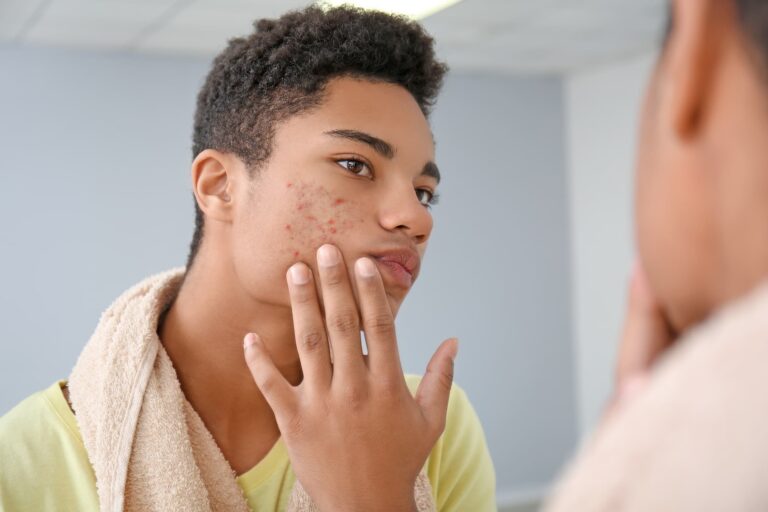
Figure 1. A girl stares into a mirror with a worried look regarding her acne.
Approximately 50 million individuals in the US experience acne yearly, with 85% of these individuals being between the ages of 12 to 25 (Bickers et al., 2006; Bhate & Williams, 2013). Existing research on acne’s visibility and its effect on appearance presents convincing evidence of associated underlying psychological impacts. The effects of acne increases the chance of change with an individual’s self-perception that “can go far deeper than the surface of the skin” (Ayer & Burrows, 2006); in fact, acne is associated with negative connotations such as “embarrassment, stigma, shame, [and] guilt,” which further induces the psychological effects (Halvorsen et al., 2011). Ultimately, what is at stake here is the affected individual’s overall quality of life as long as the condition persists.
The rise in mental health issues among college students is worsened by the psychosocial adverse effects of acne. According to the feedback from students in English 105, there is a substantial number of students who have experienced acne (90.3%) compared to the number of students who have not (9.7%). Of those students who have experienced acne, 25.8% reported experiencing anxiety, and 3.2% reported experiencing depression due to the condition; moreover, students with acne reported often suffering from low self-esteem (41.9%) and negative body-image (29%). Existing research has found acne to actually be associated with anxiety and depression. Logically, when a student interacts with another student, the first feature to grasp their attention would be the student’s face. So, if that student is struggling with the physical effects of having mild to severe acne, the likelihood of those effects becoming a stressor that leads to a mental health disorder increases. The rapid and random changes that concur with having acne often lead to low self-esteem (Natsuaki & Yates, 2021), negative body-image (Dalgard et al., 2008), social isolation (Jafferany & Pastolero, 2018), and more; these effects are essentially interconnected, triggering the development of anxiety and depression. As Panda (2024) found, “individuals with severe acne report[ed] significantly lower self-esteem, higher anxiety, and more severe depressive symptoms,” highlighting the severity of living with acne. College students are typically in an environment that is filled with people from diverse backgrounds and various appearances. For those struggling with acne, this situation can be particularly intimidating, as it may lead them to compare their appearance with that of peers who do not share the same condition. This feeling of insecurity could bring about those self-image related issues and contribute to the rise of anxiety and depression. Interestingly, researchers found that about 44% of their study’s participants (with acne) had anxiety, and 49% had depression (Molla et al., 2021). Moreover, students’ struggle with acne can impact their self-confidence and lead to feelings of insecurity (Hammill & Vaillancourt, 2023). In a study conducted by Gupta and Gupta (1998), they found that 4% to 7% of individuals who struggle with acne reported signs of suicidal ideation. Therefore, acne is not only a physical problem but also a psychological warfare for individuals affected by its presence.
College students battling acne’s negative effects are dampening their academic success. For many students, college is a place of opportunities and growth. However, when acne begins to affect students’ mental well-being, it can create issues during their pursuit of higher education. Various symptoms of anxiety and depression not only impact students’ performance but also their ability to show up for class (Bernal-Morales et al., 2015). The thought of your peers staring at your face and judging would make anyone feel uneasy. Having to endure those intense feelings can drive students suffering from acne to seek validation from others, increasing the likelihood of developing a mental health disorder (Hammill & Vaillancourt, 2023). College students have serious responsibilities, such as attending classes, completing homework, participating in class, building connections, and others; their future depends on their ability to encompass all of those responsibilities. However, with mental health disorders, their association with a higher level of stress is restricting students from performing basic functions such as “concentration and memory, which are critical for academic success” (Bernal-Morales et al., 2015). Many of those students’ responsibilities rely on their ability to concentrate and memorize important content or materials. Researchers suggest that students experiencing depression are also unmotivated, which decreases their overall performance in their academic work and impacts their semester grades (Bernal-Morales et al., 2015). Acne’s effect on its victims’ self-perception of their appearance can influence them to exclude themselves from all school-related activities beyond simple attendance. Exclusion can impact a student’s academic career as a whole by possibly increasing the risk of getting kicked out of college. Ultimately, acne’s effect on the psychosocial well-being of college students hinders their ability to thrive within a college environment.
There is a lack of awareness regarding the psychological effects of acne on college students. According to Natsuaki and Yates (2021), many students who struggle with their mental well-being tend to go unnoticed by their families, peers, professors, and even healthcare professionals. Dermatologists, in particular, are medical doctors who specialize in treating the skin, hair, and nails. Feedback from English 105 students revealed that 38.7% found their visit to a healthcare professional for acne helpful; however, the same percentage reported that the professional did not ask about their mental well-being during the visit. This suggests that healthcare professionals are mostly focused on providing treatment for acne’s effect on the surface of one’s skin rather than addressing its psychological effects. In Jill Hendon’s sharing of her personal experience, she recounts suffering from severe acne as a college student; she visited a dermatologist who performed injections and prescribed medicine to improve her acne, but this attempt at improvement backfired by worsening her acne (Hendon, 2004). The dermatologist quickly provided treatment for the acne but failed to acknowledge possible side effects, such as the worsening of her acne and a decline in her mental health. Jill stated that her “face was covered with large, red, draining bumps,” which affected her confidence. She became self-conscious of her appearance and wanted to hide her face (Hendon, 2004). There seems to be less focus on the affected individual’s quality of life, wherein a study found that 30.3% of respondents with acne felt dismissed by a medical professional (Ra et al., 2021). Additionally, researchers found that many individuals felt supportless and alone, as “they either felt shut down by their surrounding social network or felt that nobody else would understand them” (Ra et al., 2021). Acne’s life-changing effects are worthy of attention to mitigate its effects on an individual’s quality of life.
It can be conclusively stated that acne is more than a condition that affects individuals’ skin, and it requires additional treatment besides prescribing acne-related medications. Therefore, a holistic approach to address acne’s severity will properly provide students with better care. I envision a holistic approach that encompasses the psychological and social effects of acne on individuals’ well-being. Dermatologists should have additional training or educational requirements to acquire the necessary skills to tackle any psychosocial issue that is affecting their patients. An additional requirement could consist of taking a psychology course beyond the introductory level to foster an understanding of how one’s mind is interconnected with one’s body. This can provide insightful information that can aid in the decision-making process of curating treatment plans for patients experiencing acne. Dermatologists should think about dietary changes, herbal medicines, natural products, and more before going straight into prescription medications. In general, anyone who knows someone who is battling with acne should be educated in regard to its psychological and physical impact on that person. Family, friends, and even professors should attend and support programs designed to inform them about mental health disorders so they can recognize any signs they may have overlooked when interacting with someone who has acne. These resources and programs are offered online as well, sources for online education and support include social media mental health influencers, HealthTalk (Healthtalk, 2022), National Alliance on Mental Illness (NAMI, 2025), and more. In fact, researchers found that 57.3% of individuals with acne reported that they would benefit from a support line or group for acne sufferers (Ra et al., 2021). Overall, this study has some limitations as the sample size within my survey was small, and I did not account for all mental health disorders. Nonetheless, college students dealing with acne need support and reassurance that they matter and are normal, just like everyone else.
References
Ayer, J., & Burrows, N. (2006). Acne: more than skin deep. Postgraduate Medical Journal, 82(970), 500–506. https://doi.org/10.1136/pgmj.2006.045377
Bernal-Morales, B., Rodríguez-Landa, J. F., & Pulido-Criollo, F. (2015). Impact of Anxiety and Depression Symptoms on Scholar Performance in High School and University Students. A Fresh Look at Anxiety Disorders. https://doi.org/10.5772/60711
Bhate, K., & Williams, H. C. (2013). Epidemiology of acne vulgaris. British Journal of Dermatology, 168(3), 474–485. https://doi.org/10.1111/bjd.12149
Bickers, D. R., Lim, H. W., Margolis, D., Weinstock, M. A., Goodman, C., Faulkner, E., Gould, C., Gemmen, E., & Dall, T. (2006). The burden of skin diseases: 2004: A joint project of the American Academy of Dermatology Association and the Society for Investigative Dermatology. Journal of the American Academy of Dermatology, 55(3), 490–500. https://doi.org/10.1016/j.jaad.2006.05.048
Dalgard, F., Gieler, U., Holm, J. Ø., Bjertness, E., & Hauser, S. (2008). Self-esteem and body satisfaction among late adolescents with acne: Results from a population survey. Journal of the American Academy of Dermatology, 59(5), 746–751. https://doi.org/10.1016/j.jaad.2008.07.013
Davern, J., & O’Donnell, A. T. (2018). Stigma predicts health-related quality of life impairment, psychological distress, and somatic symptoms in acne sufferers. PLOS ONE, 13(9), e0205009. https://doi.org/10.1371/journal.pone.0205009
Garrick, N. (2016, September 1). Acne. National Institute of Arthritis and Musculoskeletal and Skin Diseases. https://www.niams.nih.gov/health-topics/acne
Gupta, M. A., & Gupta, A. K. (1998). Depression and suicidal ideation in dermatology patients with acne, alopecia areata, atopic dermatitis and psoriasis. British Journal of Dermatology, 139(5), 846–850. https://doi.org/10.1046/j.1365-2133.1998.02511.x
Halvorsen, J. A., Stern, R. S., Dalgard, F., Thoresen, M., Bjertness, E., & Lien, L. (2011). Suicidal Ideation, Mental Health Problems, and Social Impairment Are Increased in Adolescents with Acne: A Population-Based Study. Journal of Investigative Dermatology, 131(2), 363–370. https://doi.org/10.1038/jid.2010.264
Hammill, C., & Vaillancourt, T. (2023). Acne and its association with internalizing problems. Dermatological Reviews, 4(5). https://doi.org/10.1002/der2.181
Healthtalk. (2022, January 11). Healthtalk. https://healthtalk.org/experiences/acne/family-life-and-acne/
Hendon, J. (2004). Acne: A patient’s point of view. Journal of the American Academy of Dermatology, 51(1), 39–39. https://doi.org/10.1016/j.jaad.2004.01.024
Jafferany, M., & Pastolero, P. (2018). Psychiatric and Psychological Impact of Chronic Skin Disease. The Primary Care Companion for CNS Disorders, 20(2). https://doi.org/10.4088/pcc.17nr02247
Molla, A., Alrizqi, H., Alharbi, E., Alsubhi, A., Alrizqi, S., & Shahada, O. (2021). Assessment of Anxiety and Depression in Patients with Acne Vulgaris in Medina: A Case-Control Study. Clinical, Cosmetic and Investigational Dermatology, 14, 999–1007. https://doi.org/10.2147/CCID.S302311
NAMI. (2025). NAMI: National Alliance on Mental Illness. NAMI: National Alliance on Mental Illness. https://www.nami.org
Natsuaki, M. N., & Yates, T. M. (2021). Adolescent Acne and Disparities in Mental Health. Child Development Perspectives, 15(1), 37–43. https://doi.org/10.1111/cdep.12397
Panda, S. (2024). Acne and its multifaceted impact on students: Prevalence, mental health, and self-treatment practices. Annals of Medical and Surgical Dermatology, 2(2). https://doi.org/10.61577/amsd.2024.100009
Ra, A. G., Ho, B., Bickerstaffe, L., & Bewley, A. (2021). More than skin deep: a survey of real‐life experiences of acne vulgaris. British Journal of Dermatology, 186(1), 191–193. https://doi.org/10.1111/bjd.20737
Stamu‐O’Brien, C., Jafferany, M., Carniciu, S., & Abdelmaksoud, A. (2020). Psychodermatology of acne: Psychological aspects and effects of acne vulgaris. Journal of Cosmetic Dermatology, 20(4). https://doi.org/10.1111/jocd.13765