
Demystifying Crime: Weaknesses and Paths Forward in Criminological Theory

Every individual has the capacity for crime. Though unconscionable for many, given a particular time and place, even the most morally steadfast may act in ways that advance their self-interest without regard for the law. Criminology, the study of such a phenomenon, is a complex field positioned at the intersection of varying disciplines, combining elements of psychology and sociology. Unfortunately, criminological theory, the foundation from which research is conducted, is severely lacking in explanatory power, as many prevalent theories in the field are contradictory and unsupported by empirical evidence (Wikström & Kroneberg, 2022). Some theories suggest crime is an entirely learned behavior, others suggest it is a product of conflicting motivations. With so many entirely different explanations and study designs, empirical evidence can be interpreted in a wide variety of ways, proving an obstacle for criminologists seeking a rigorous explanation for criminal behavior. Given limitations in prior research, the Situational Action Theory model is the most promising avenue forward in explaining the mechanisms of crime, enhancing the understanding of its causes, and providing a basis from which better policy outcomes may be achieved.
A pressing difficulty in navigating the complex and often incompatible models in explaining criminal behavior rests in clearly and consistently defining crime. Crime is a social phenomenon typically identified under a particular framework subject to heavy debate. Firstly, it is recognized that existing in a society necessitates adherence to certain rules in the interest of protecting our own wellbeing and furthering that of others. Thus, it is necessary to defer to law in justifying such a definition. Laws, however, vary across both cultures and time periods, thus no universally accepted definition exists.
It is theorized that such variance can be accounted for by the sociocultural position on criminality shifting nonrandomly. Where economic conditions and political rhetoric converge lies a connection between more traditionalist historical analysis and a distinct social labeling reflex, advanced through criminologist Dario Melossi’s “grounded labeling theory.” Melossi suggests that periods of positive economic conditions are primarily characterized by a sympathetic view of crime, while periods of negative economic conditions are characterized by a distinctly contemptuous view of crime (Melossi, 2000). This disdainful attitude may stem from a polarizing anxiety that shifts public opinion towards a harsher attitude (Melossi, 2000). Such a theory may explain the ebbs and flows of political rhetoric, evidenced by the stark contrast between a paternalistic regard for protests and calls for “law and order” or a “return to normalcy” societies may experience in a relatively short period of time (Melossi, 2000). For the purposes of this exploration, crime will be defined as an action punishable by a state authority.
As with most types of behavior, determining an individual’s exact propensity for crime remains a challenge. Criminological theorists, by virtue of the field, are tasked with comprehensively explaining what may be inexplicable. Despite these limitations, it is understood that while many factors inform criminality, identifying these factors, both explicit and implicit, prove a momentous task. Placed in an environment with various stimuli and competing interests, human cognition becomes a “black box”, in which the stimuli and resulting behavior are clear, but the process by which an individual produces the behavior remains ever elusive (Wikström & Kroneberg, 2022). Additionally, researchers struggle to identify the causal link, as analysis tends to yield correlative indicators rather than causative factors (Wikström & Kroneberg, 2022).
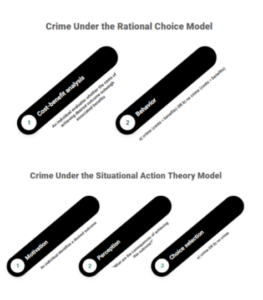
In essence, researchers struggle to identify what causes crime rather than where they can most reasonably expect to find it. One of the most favored theories in the field, the Rational Choice model, asserts crime is both expected and rational given particular environmental stimuli (Piliavin et al., 1986). In short, the theory suggests that individuals sort priorities, evaluate hypothetical outcomes, and make the rational choice, or the choice most likely to bring about a desired outcome (McCarthy, 2002). This model, however, fails to explain phenomena such as crimes of passion (Wikström & Kroneberg, 2022). When a rational actor becomes irrational, the theory loses the ability to explain criminal behavior.
Additionally, the model rests on the assumption that an actor has access to perfect information, setting an unrealistic standard for the model. Individuals lack omnipotence, severely limiting the theory’s practical applicability. What’s more, empirical evidence suggests that punishing crime produces results inconsistent with these assumptions, casting doubt on the utility of such a model (Piliavin et al., 1986). For example, it is assumed individuals evaluate relative risk while deliberating illegal activity, however, the legal risk an individual undertakes does not affect their actual behavior (Piliavin et al., 1986). If there is sufficient motive to commit a crime, one will occur, with little respect for potential consequences. Ultimately, a strict cost-benefit analysis that assumes perfect conditions seems to lack the explanatory power researchers are looking for.
Fortunately, Situational Action Theory, as pioneered by researchers at the University of Cambridge, is promising in addressing these shortfalls. Though the precise timeline of its origins are unclear, in the early 2000s criminology professor Per-Olaf Wikström recognized the challenges of contradictory findings in the field according to Cambridge’s Center for Analytic Criminology (2023). Wikström, alongside colleagues, argued for a more rigorous investigation into the mechanisms of crime. The first observation was that it was necessary to lay the foundations for determining a causal link (Wikström & Kroneberg, 2022). Notably, cross-sectional studies in criminology had a serious weakness. Such studies collect data on individuals at one specific period in time. With no temporal comparison, meaningful information about causation is difficult to parse.
The second observation was that crime is likely to have a situational component (Wikström & Kroneberg, 2022). Every individual is subject to the influences, however subtle, of our environment. The underlying process behind crime may be more complicated than entirely internal motivations. Together, these two observations drove the development of Situational Action Theory. The assumptions on which it rests differ substantially from previous theories, centering crime as a moral, rather than rational decision (Sattler et al., 2022). Situational Action Theory assumes individuals are guided by rules, shared rules provide a social order, causation stems from situational action, and that crimes are informed by a philosophical filter, rather than a cost-benefit analysis (Wikström & Kroneberg, 2022).
Under this model, an individual experiences a motivation, such as a desire to achieve an outcome, a perception, in which they weigh potential consequences and alternatives, and a choice selection process, from which an action, or inaction emerges (Wikström & Kroneberg, 2022). These components make Situational Action Theory distinct, and provide compelling points of analysis. In essence, Situational Action Theory finds that crime occurs principally because it is admissible by an individual in that moment, as no sufficiently strong external deterrent or the violation of a personal moral code disallows the action (Wikström & Kroneberg, 2022). It differs from Rational Choice Theory in a few key ways. The theory identifies and names the mechanical process only implicitly recognized in the Rational Choice model, pairing an analysis of internal propensity with environmental influences to determine causation. This so-called “analytic criminology” attempts to combine insights into the mechanisms of crime from previous theories, finding relative success in its ability to distinguish between three key components (Wikström & Kroneberg, 2022).
Firstly, causative factors, or inputs, consist of both individual propensity, such as impulsivity, and environmental influences, such as conformity. The interaction between these inputs, or the person-environment interaction, constitute the second component: the cause. The presence of a cause triggers the choice selection process, thus generating the final component, an effect (Wikström & Kroneberg, 2022). Collectively, these three elements bolster the theory, incorporating the most prevalent factors behind an instance of crime.
In application, Situational Action Theory fares somewhat well in explaining the causes of crime. One experimental study tested its mechanisms through a hypothetical presented to participants concerning the sale of prescription drugs. The researchers found evidence that a “moral filter” informed the decisions individuals made, hinting at a branch of conditions behind a crime (Sattler et al., 2022). Despite its strengths however, there are some areas of weakness. Empirical findings fail to support the assumption that the moral filter acts on the perception process, and with respect to the choice process, data show that deterrence does not work well on individuals with low self control (Sattler et al., 2022). Additionally, another key component of the theory is the difference between habitual and non-habitual crime. Delineating between the two, and the ways they influence the likelihood of a crime occurring, remains a challenge (Pauwels et al., 2018).
Despite these mixed results, with some studies supporting some elements of the theory over others, research appears promising. The insights such a theory grant may be useful in navigating policing and legal reform. Situational Action Theory suggests the selection process influences an individual’s environment (Wikström & Kroneberg, 2022). Manipulating such an environment to disincentivize selection may be an effective means of deterrence, though near impossible to implement without infringing on personal freedoms. Likewise, variations in the moral filter component are difficult, if not impossible to rectify. However, addressing habitual behaviors and rendering crime an ineffective means of accomplishing common goals may help. Egalitarian economic policies, such as social safety nets, may address sentiments of desperation.
Fundamental differences in values, such as the antagonism between egalitarian and antiegalitarian beliefs, may serve as an obstacle however. Criminologists James Unnever, Francis Cullen, and James D. Jones find an association between public opinion and policy. Data from the 2000 American National Election Survey shows a demographic through-line in individual punishment and systemic reform. Unfavorability towards welfare, for example, is associated with a lack of support in addressing the “root causes” of crime (Unnever et al., 2008). Despite this challenge, in the policy sphere, harsh and disproportionate sentences coupled with an incredibly high incarceration rate make for a poor environment. This environment in turn produces a selection choice process that favors crime under Situational Action Theory. If an environment makes an individual more likely to select for crime-causing companions and settings, said environment creates a devastating cycle. American recidivism rates in particular, are startlingly high, with approximately 70% of released prisoners seeing rearrest within three years (Alper et al., 2018). Incorporating released prisoners into programs which provide financial recovery services, housing assistance, and a career network decreases the likelihood that the selection process under Situational Action Theory will result in crime.
Ultimately, Situational Action Theory presents a promising perspective on the mechanism behind crime, and addresses the severe limitations of one of the most prevalent theories. Its consideration of both internal and external factors that inform decision making, coupled with its analytic criminological origins, produce a robust theory that demands further inquiry. With respect to internal motivations for example, the extent of one’s self-control is necessarily subjective. Future research that further inquires into Situational Action Theory’s perception process, while standardizing a descriptive scale of willpower might uncover a greater complexity. While not perfect, empirical research into its mechanisms is promising, and its individual components create space for practical policy recommendations, such as widened support networks for released prisoners and more robust social safety nets, which may alleviate criminal urges, and promote societal wellbeing.
I attest that this submission did not use AI at any stage in its development or in the creation of
any of its components.
Bibliography
Alper, M., Durose, M. R., Markman, J. (2018). 2018 update on prisoner recidivism: A 9-year
follow-up period (2005-2014). Bureau of Justice Statistics. https://bjs.ojp.gov/library/publications/2018-update-prisoner-recidivism-9-year-follow-pe
riod-2005-2014
McCarthy, B. (2002). New Economics of Sociological Criminology. Annual Review of Sociology,
28, 417-442. https://doi.org/10.1146/annurev.soc.28.110601.140752
Melossi, D. (2000). Changing representations of the criminal. The British Journal of
Criminology, 40(2), 296–320. https://doi.org/10.1093/bjc/40.2.296
Pauwels, L. J. R., Svensson, R., Hirtenlehner, H. (2018). Testing Situational Action Theory: A
narrative review of studies published between 2006 and 2015. European Journal of
Criminology, 15(1), 32-55. https://doi.org/10.1177/1477370817732185
Piliavin, I., Gartner, R., Thornton, C., & Matsueda, R. L. (1986). Crime, deterrence, and rational
choice. American Sociological Review, 51(1), 101–119. https://doi.org/10.2307/2095480
Sattler, S., van Veen, F., Hasselhorn, F., Mehlkop, G., Sauer, C. (2022). An experimental test of
situational action theory of crime causation: Investigating the perception-choice process. Social
Science Research, 106. https://doi.org/10.1016/j.ssresearch.2021.102693
Situational Action Theory (SAT). (2023). Center for Analytic Criminology. University of
Cambridge. https://www.cac.crim.cam.ac.uk/resou/sat
Unnever, J. D., Cullen, F. T., & Jones, J. D. (2008). Public support for attacking the “root causes”
of crime: The impact of egalitarian and racial beliefs. Sociological Focus, 41(1), 1-33.
https://doi.org/10.1080/00380237.2008.10571321
Wikström, P. H., & Kroneberg, C. (2022). Analytic criminology: Mechanisms and methods in the
explanation of crime and its causes. Annual Review of Criminology, 5(1), 179-203.
https://doi.org/10.1146/annurev-criminol-030920-091321
Wikström, P. H., & Kroneberg, C. (2022). Analytic criminology: Mechanisms and methods in the
explanation of crime and its causes. Annual Review of Criminology, 5(1), 179-203.
https://doi.org/10.1146/annurev-criminol-030920-09132