
How did authors’ race and written dialect usage in the Southern Life History Project (SLHP) affect the authentic representation of Black voices?

Introduction:
The Federal Writers Project (FWP), part of the New Deal, aimed to document American life during the Great Depression (Hirsch, 12). One such initiative within the FWP was the Southern Life History Project (SLHP), a regional effort directed by W.T. Couch (Hirsch, 147). The SLHP aimed to counter negative stereotypes of Southerners by collecting life histories from “ordinary” individuals, presenting an authentic portrayal of Southern life in their own words (Hirsch, 147- 148). Our ENGL 482 research group studied a sample of life histories from North Carolina using digital humanities methods, including metadata analysis, text analysis, and data visualizations. Our analysis revealed racial disparities in authorship and racial framing of written dialect in these life histories. These findings reveal that the SLHP’s racial disparities in authorship and racialized framing of written dialect compromised the authenticity of Black interviewees’ life histories by prioritizing White perceptions of authenticity over accurate portrayals of Black interviewees’ narratives.
Background:
In the 1930s, the U.S. faced economic devastation in the Great Depression and racial inequities exacerbated by Jim Crow laws (Library of Congress, 16:08-18:00). President Franklin Roosevelt established a series of federal programs, called the New Deal, to address the economic challenges and unite Americans at a time of division and strife (Library of Congress, 19:00- 22:00). The Federal Writers’ Project, established under the Works Progress Administration (a New Deal agency), hired unemployed people with any level of writing experience to produce cultural documentation of the U.S. (Hirsch, 12; Library of Congress, 19:00-20:10).
As part of the FWP, W.T. Couch, the Southeast regional FWP director, helped initiate the Southern Life History Project (SLHP) (Hirsch, 147). Couch envisioned the SLHP as a way for Southerners to tell their own stories, challenging stereotypes embedded in popular culture of the Southern poor as “degenerate, stunted, and starving people” and “parodies of human beings” (Hirsch 147-149). Life histories would theoretically provide an alternative documentation of Southern life to the media’s negative portrayals, as well as the existing abstract, removed, and sociological accounts of the South (Hirsch, 150-151, 157).
SLHP writers were tasked with selecting their own life history subjects. The interviewers received instructions for writing life histories, including suggested interview questions and guidance on writing up the interviews (Hirsch, 152). The instructions particularly concerned how to collect accurate stories and avoid expressing judgement to interviewees, conveying Couch’s desire for an authentic portrayal of the South (Couch, 418). Couch also “wanted to reach a large audience” and would modify life histories to “make [them] better organized and easier to read”, even excluding some life histories from the published collection to not “make a bad situation worse” regarding the portrayal of Southerners (Hirsch, 154). Couch’s SLHP evidently had conflicting goals of authentically portraying individuals’ stories and shaping the stories according to readers’ perceptions.
Methods:
Our research group studied a sample of North Carolina’s life histories using digital humanities methods including metadata analysis, text analysis, and data visualizations. Each group member selected six life histories from the North Carolina collection, contributing to our corpus of 132 life histories. We created a metadata schema including the demographics, narrative elements, and contextual elements of the corpus. The metadata terms mentioned in this paper include Writer Race, Interviewee Race, Written Dialect, and Racialized Language. For each of these terms, the group created definitions to guide data analysis, though researcher interpretation may have introduced variability. After analyzing and determining metadata from each selection, the metadata was entered into a shared spreadsheet. We then used Tableau to visualize the metadata. To complete the text analysis, each life history was converted to plain text and added to the metadata spreadsheet. Due to the project’s time constraints, the plain text conversions were not compared word-for-word to the life history archives, potentially resulting in errors. We used Voyant to create visualizations of the text analysis and identify excerpts for close readings.
Data and Findings:
Figure 1:

Figure 1 explores writer race based on interviewee race. The figure shows that White writers authored all life histories of White interviewees (66 out of 66), and 71% (27) of Black or Multi Racial interviewees’ accounts. Black writers did not author any White interviewees’ narratives, and only 27% (11) of Black or Multi-Racial interviewees’ life histories. These findings reveal a significant racial disparity among SLHP authors and suggests that most narratives were filtered through White authors’ lenses.
Figure 2:
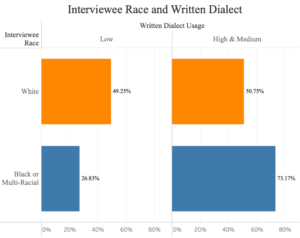
Figure 2 explores written dialect usage based on interviewee race. The vast majority (73.17%, 30) of Black or Multi-Racial interviewees’ life histories featured Medium or High written dialect, compared to only 50.74% (34) of White interviewees’ narratives. Nearly half (49.25%, 33) of White interviewees’ life histories had Low dialect usage, while only a quarter (26.83%, 11) of Black or Multi-Racial interviewees’ accounts did. This metadata reveals the disparate use of written dialect in Black or Multi-Racial interviewees.
Figure 3:
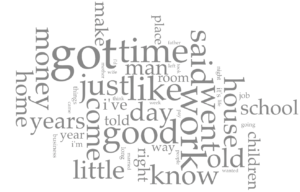
Figure 4:

Figures 3 and 4 are word clouds generated from the top 50 words used in White (Figure 3) and Black or Multi-Racial (Figure 4) interviewees’ life histories. The red terms are written dialect, and the words’ size reflects the relative count (the larger the word, the more times it appears). These visualizations support the metadata findings that dialect terms are more prevalent in Black or Multi-Racial interviewees’ narratives, compared to White interviewees’ narratives.
Table 1:
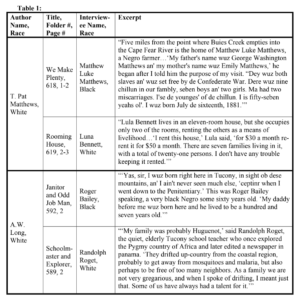
Table 1 provides comparative excerpts for a close reading of authors’ introductions to Black and White interviewees. The writers’ introductions of Black interviewees emphasize race and use heavy dialect, while White interviewees’ introductions mainly address occupation or personality. For example, T. Pat Matthews introduces Bennett as someone managing an eleven-room house and does not use written dialect. In contrast, the author introduces Luke Matthews with racialized descriptors, referring to him as “a Negro farmer”, and shortly after, renders his speech with heavy written dialect: “‘Dere wuz nine chillun in our fambly, seben boys an’ two girls. Ma had two miscarriages. I’se de younges’ of de chillun. I is fifty-seben yeahs ol’.’” (Folder 618, 2).
A similar pattern appears in A.W. Long’s introductions of Randolph Roget, a White man, and Roger Bailey, a Black man. Long’s introduces Roget as a “quiet, elderly Tucony school teacher”, emphasizing his occupation and accomplishments (Folder 589, 2). In contrast, Long introduces Bailey as a “very black Negro man”, and uses heavy written dialect, such as “‘Yas, sir, I wuz born right here in Tucony, in sight ob dese mountains, an’ I ain’t never seen much else, ‘ceptinr when I went down to the Penitentiary.’” (Folder 592, 2). Comparing both authors’ framing of and use of written dialect suggests that it functions as a racial marker in Black interviewees’ life histories.
Discussion:
Racial Disparities in Authorship
The SLHP’s racial disparities in authorship undermined the narratives’ authenticity by centering White voices. As Figure 1 suggests, White writers authored nearly all life histories, including those of Black and White interviewees, while few life histories were authored by Black writers. This unrepresentative authorship reflects broader structural biases within the FWP (Stewart, 124). In 1936, no Black staff members worked on any state’s FWP project, and although this number increased to 140 by 1938, 14 states still employed all White staff (Stewart, 124). Stewart highlights that the FWP systemically excluded Black writers from authorship and leadership roles, even replacing qualified Black individuals with White employees (Stewart, 123). Additionally, the FWP paid the few Black workers who were employed far lower wages than their White colleagues (Stewart, 123). These practices reveal that the FWP privileged White voices in authorship and leadership roles.
This centering of White writers in the SLHP affected the life histories’ authenticity, as White writers often avoided interviewing Black individuals and experienced power imbalances when they did. Hirsch demonstrates this dynamic, noting that Couch had to tell project workers: “We must have life histories that reveal the way people in the South live, and Negroes and members of other racial groups are people just as well as whites.” (Hirsch, 153). The need for this reminder reveals the SLHP’s consideration of Black narratives as secondary or optional, perpetuating a framework that centered White perspectives in the South. The FWP’s Ex-Slave Studies project further illustrates how the racial dynamic between interviewer and interviewee shaped the narratives’ authenticity (Musher, 1; Escott, 17). In the project, predominantly White interviewers collected narratives from formerly enslaved people, and both Musher and Escott argue that these interactions constrained the narratives’ authenticity (Musher, 12; Escott, 17). Interviewees often tailored their stories to align with social norms concerning speaking with White people about enslavement, limiting the honesty and depth of their accounts of slavery (Musher, 12; Escott, 17). Furthermore, Stewart writes that White FWP editors and state directors frequently rewrote project workers’ submissions to “more accurately reflect ‘historical reality’ as it appeared to a white perspective” (Stewart, 140). These findings reveal that the SLHP’s reliance on White writers and editors compromised the portrayal of Black voices by prioritizing White perceptions and comfort over authentic representation.
Racial Framing of Written Dialect
SLHP writers and editors’ use of written dialect in Black interviewees’ life histories catered to White readers’ and writers’ perceptions of authenticity, potentially at the expense of accurately portraying Black interviewees’ stories. As Figures 2-4 show, Black and Multi-Racial interviewees’ life histories disproportionately included heavy written dialect compared to those of White interviewees. Table 1 reveals that written dialect in Black interviewees’ narratives was explicitly tied to race, while in White interviewees’ narratives, it was rare and disconnected from racial identity. Similar dynamics appear in the Ex-Slave Studies project, where White writers more frequently authored formerly enslaved people’s narratives in the first-person and emphasized the interviewees’ dialect to construct authenticity (Musher, 19). In contrast, Black writers more often wrote in third person avoiding heavy dialect, and emphasized interviewees’ accomplishments instead (Musher, 19). These patterns suggest that the use of written dialect was not a neutral portrayal of authentic voice, but instead reflected broader racialized perceptions of authenticity held by the FWP workers and audience.
FWP writers’ and editors’ emphasis on written dialect reflects their editorial aims to cater to White readers’ expectations. In the Mississippi Ex-Slave Studies project, workers submitted narratives only if they were “written in the first person and which used black dialect” to “persuade readers that the texts accurately captured ‘authentic’ experiences” (Musher, 18). This prioritization of dialect often came at the expense of narrative substance. As Musher notes, writers who focused on how interviewees spoke frequently overlooked their “achievements, such as roles as teachers, preachers, businessmen, and politicians” (Musher, 19). Table 1 aligns with this dynamic, showing that Black interviewees were often defined primarily by their race, while White interviewees were described by their accomplishments. These editorial choices reveal that White FWP writers emphasized Black interviewees’ dialect to meet White readers’ expectations, prioritizing racial markers of authenticity over the actual content of interviewees’ stories.
Conclusion:
The metadata and text analysis findings reveal that the SLHP’s racial disparities in authorship and racialized framing of written dialect compromised the authenticity of Black interviewees’ life histories by prioritizing White perceptions of authenticity over accurate portrayals of Black interviewees’ narratives. One of the SLHP’s primary goals was to collect authentic representations of people in the South, and these findings demonstrate the structural racial biases embedded in the FWP, distorting the documentation of Black interviewees’ voices. Moving forward, additional analysis should be conducted on how power dynamics between SLHP writers and interviewees based on race, gender, socioeconomic status, and other identities shape the lens through which stories are documented.
References:
Hirsch, Jerrold. Portrait of America: A Cultural History of the Federal Writers’ Project. University of North Carolina Press, 2003.
Library of Congress. “Soul of a People.” YouTube, 10 January 2014,
https://www.youtube.com/watch?v=apInQYW9s1w&t=1949s.
Couch, W T. “Preface.” These Are Our Lives. W.W. Norton & Company Inc, New York, NY, 1939, pp. ix–xx.
—. W T. “Instructions to Writers.” These Are Our Lives. W.W. Norton & Company Inc, New York, NY, 1939, pp. 417-421.
“We Make Plenty” written by T. Pat Matthews, November 27, 1938, Folder 618 in the Federal Writers’ Project papers #3709, Southern Historical Collection, The Wilson Library,
University of North Carolina at Chapel Hill.
“Rooming House” written by T. Pat Matthews, January 20, 1939, Folder 619 in the Federal Writers’ Project papers #3709, Southern Historical Collection, The Wilson Library, University of North Carolina at Chapel Hill.
“Janitor and Odd Job Man” written by A. W. Long, February 15, 1939, Folder 592 in the Federal Writers’ Project papers #3709, Southern Historical Collection, The Wilson Library, University of North Carolina at Chapel Hill.
“Schoolmaster and Explorer” written by A. W. Long, May 14, 1939, Folder 589 in the Federal Writers’ Project papers #3709, Southern Historical Collection, The Wilson Library, University of North Carolina at Chapel Hill
Stewart, Catherine A. “Chapter 5: The Everybody Who’s Nobody: Black Employees in the Federal Writers’ Project”. Long Past Slavery: Representing Race in the Federal Writers’ Project. University of North Carolina Press, Chapel Hill, NC, 2016, pp. 120-142.
Musher, Sharon Ann. “Contesting ‘The Way the Almighty Wants It’: Crafting Memories of Ex Slaves in the Slave Narrative Collection.” American Quarterly, vol. 53, no. 1, 2001, pp. 1–31. JSTOR, http://www.jstor.org/stable/30041871. Accessed 26 Nov. 2024.
Escott, Paul D. Slavery Remembered: A Record of Twentieth-Century Slave Narratives. Chapel Hill, University of North Carolina Press. HeinOnline,
https://heinonline.org/HOL/P?h=hein.slavery/uncaadb0001&i=1.
Rapport, Leonard. “How Valid Are the Federal Writers’ Project Life Stories: An Iconoclast among the True Believers.” The Oral History Review, vol. 7, 1979, pp. 6–17. JSTOR